Address: Langfords | Friars Hill Rd | St. John's. Antigua | Email: dsjbchancery@gmail.com | Tel: 1-268-461-1135

Not Mine to Give: Why the Homily Stays with the Priest and Deacon — and Where the Laity Truly Shine

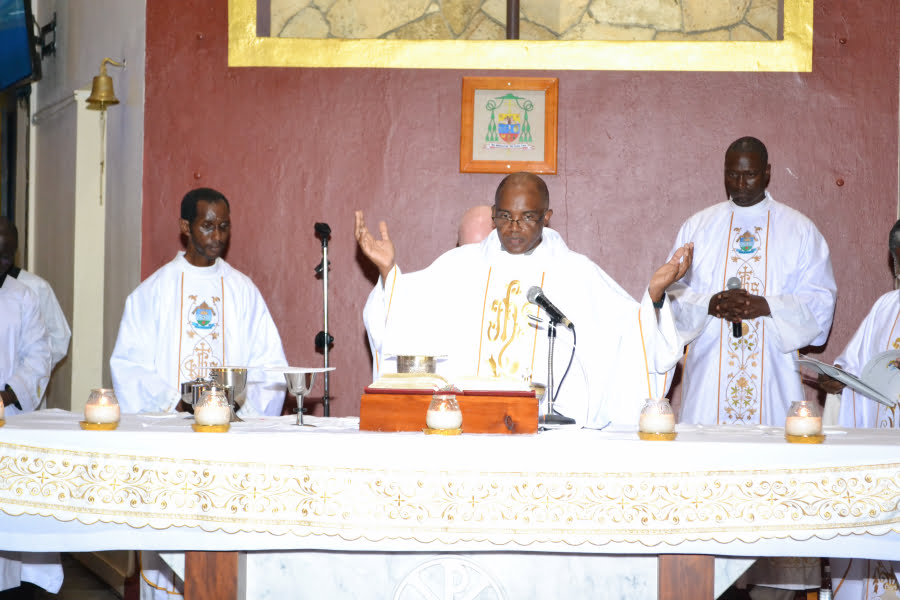
On June 17, 2026, the Vatican’s Dicastery for Divine Worship and the Discipline of the Sacraments gave a clear answer to a question that surfaces ever so often in parishes here: could a lay person, however gifted or well-formed, ever step into the ambo and deliver the homily at Mass? Cardinal Arthur Roche, responding to a request from the Bishops’ Conference of Germany, wrote back with gratitude for the pastoral concern behind the request, but with an answer that did not change: no.
For the parishes, school communities and prayer groups of our own diocese — spread across Antigua and Barbuda, St. Kitts and Nevis, Anguilla, Montserrat, Virgin Gorda and Tortola — this is a timely moment to revisit what the Church actually teaches on this point, and just as importantly, what room the Church does leave for the lay faithful to speak a living word to their brothers and sisters.
What Canon Law Actually Says
The Code of Canon Law is direct on this point. Canon 767 §1 describes the homily as part of the liturgy itself and states clearly that it is reserved to a priest or deacon. The General Instruction of the Roman Missal (no. 66) adds that the celebrant may entrust it to a concelebrating priest or to a deacon — but never to a lay person, even a religious sister, seminarian, theology graduate, or long-serving catechist.
This is not a matter of talent or holiness. A gifted lay catechist may know Scripture more thoroughly than some clergy, and that is a gift the Church treasures. But the homily is not simply a scriptural talk; it is an act rooted in the sacrament of Holy Orders. The priest or deacon preaches as one configured to Christ through ordination, drawing the proclaimed Word directly into the Eucharistic sacrifice that follows. It is this sacramental link — not a judgment on ability — that keeps the homily reserved to the ordained.
“The reservation of the homily to a priest or deacon is not a merely disciplinary norm, but derives from the very nature of the liturgy.”
— Dicastery for Divine Worship and the Discipline of the Sacraments, June 17, 2026
So Where Do the Laity Fit In?
Here is the good news our catechists, lectors, teachers, and lay leaders should hold onto: Canon 766 explicitly permits lay persons to preach in a church or oratory when necessity requires it, or it is genuinely useful, according to norms set by the bishops’ conference and always under the local bishop’s authority. This applies to Bible services, retreats, parish missions, school assemblies, and formation sessions — the many places where the lay apostolate of the Word is not only allowed but urgently needed, especially given the shortage of clergy across our scattered island communities.
There is also a narrower, carefully guarded allowance connected to Mass itself. Church law recognises that, for a serious reason, a lay person may be invited to offer a brief instruction or personal testimony — never a homily — after the priest has prayed the Prayer after Communion. This might happen, for example, when a parish is introducing a diocesan appeal, welcoming a mission group, or marking an occasion such as a vocations or catechetical Sunday. Even then, Church guidance is careful to note that this should not become a regular practice, and that it must never be confused with, nor substitute for, the homily the priest or deacon has already given.
In short: the ambo immediately after the Gospel belongs to the ordained minister. The wider mission of proclaiming Christ — in the classroom, at the parish hall, on the radio, at a wake-house service, in a Bible study circle, or in that brief word of testimony after Communion when truly warranted — belongs, joyfully and indispensably, to the whole People of God.
A Timely Word for Our Diocese
As our parishes prepare for the Diocesan Synodal Assembly this November, themed around “Conversation in the Spirit,” this teaching is worth sitting with rather than resisting. Synodality does not mean blurring the distinct roles within the Body of Christ; it means every member — ordained and lay — exercising their proper gift with generosity. Our priests and deacons are asked to prepare their homilies with prayer and care. Our catechists, lay ministers and school leaders are asked to keep forming themselves so that, in every setting outside the homily, they can proclaim the Gospel with confidence and skill.
Principals, parish catechetical coordinators, and youth leaders across the diocese are encouraged to use this moment as a teaching opportunity — a chance to help students and parishioners understand that this is not a restriction on the laity, but a structure that protects the unity of Word and Sacrament while opening wide the door to lay witness everywhere else.
Sources: Code of Canon Law, cc. 766–767; General Instruction of the Roman Missal, no. 66; Redemptionis Sacramentum, nos. 65 and 161; Dicastery for Divine Worship and the Discipline of the Sacraments, letter of 17 June 2026.
 English